Here is the download link for Shape-A-Shape: Print and Play Edition
Including:
1x Rules and Instructions
2x Shape Sheets
1x Object Cards
1x Answer Cards (print 7 times)
Enjoy.
All criticism is welcome.
Showing posts with label 03 - Shape-A-Shape. Show all posts
Showing posts with label 03 - Shape-A-Shape. Show all posts
Friday, 1 August 2014

Wednesday, 30 July 2014
Game 03 - Card Game: uh...
I actually think I've done as much I'd like on this game now.
I've made a few changes since last time, most notably the addition of answer cards which each player presents at the same time to each other player after everyone has made their objects (sort of like Dixit). This new approach should prevent people from unfairly influencing eachother too much and it should streamline the points process as a whole. Last time we were a bit unsure about who should guess first etc etc but hopefully this new method should fix that. The downside to this new method is that now everyone has 8 of their own answer cards as well as their 7 shapes and object card and I just worry that people will get mixed up and things'll get lost etc. I'll still be on the lookout for a simpler solution.
The answer cards look like this:
 Each player has a set of these cards (cut out and each set is numbered on the back) and presents the card they think corresponds to the shape their opponent has made.
When printing, the answer cards should be half the size of the object cards.
I still need to test things and perhaps I'll still have more than I thought to do on this game so I'll jeep the blog updated.
Honestly I'd quite like to get back into Game Maker again.
I have a few projects I want to work on including a co-op gravity game similar to the recently released 'Ibb & Obb' and inspired by the anime 'Patema Inverted' and the side-scroller sections from the game 'Super Mario Galaxy'.
Another game I'd like to work on would be a Metal Slug style game with perhaps a bit of Cave Story.
I'll make that other card game at some point too.
I've made a few changes since last time, most notably the addition of answer cards which each player presents at the same time to each other player after everyone has made their objects (sort of like Dixit). This new approach should prevent people from unfairly influencing eachother too much and it should streamline the points process as a whole. Last time we were a bit unsure about who should guess first etc etc but hopefully this new method should fix that. The downside to this new method is that now everyone has 8 of their own answer cards as well as their 7 shapes and object card and I just worry that people will get mixed up and things'll get lost etc. I'll still be on the lookout for a simpler solution.
The answer cards look like this:
When printing, the answer cards should be half the size of the object cards.
I still need to test things and perhaps I'll still have more than I thought to do on this game so I'll jeep the blog updated.
Honestly I'd quite like to get back into Game Maker again.
I have a few projects I want to work on including a co-op gravity game similar to the recently released 'Ibb & Obb' and inspired by the anime 'Patema Inverted' and the side-scroller sections from the game 'Super Mario Galaxy'.
Another game I'd like to work on would be a Metal Slug style game with perhaps a bit of Cave Story.
I'll make that other card game at some point too.
Tuesday, 29 July 2014
Game 03 - Card Game: I'm extending the time limit
I tested the game today with some friends and the feedback was very good. I more or less confirmed the changes I thought I should make. The game is still quite difficult but this isn't too big of a problem; people need to do badly sometimes. The problem is whether a blunder will completely ruin a game for someone or not. The solution to this problem (if it does become problematic) will be within the scoring (which is easy to change).
I didn't really test the scoring today but I got the feeling that 3 people is right on the limit of enough/not enough people to keep the game fair and interesting (with this points system). Although we weren't scoring today, the game was still pretty enjoyable. So I reiterate; the feedback was very good.
Since testing today I've polished a few details. The cards now look like this:

Actually I'll have to include a version without the colors for people with imbalanced ink ratios in their printer (or color-blindness). I worry that people will find it difficult to read the text (which is obviously very important). Unless I decide to use shape categories, the colors are just aesthetic.
 Oh, I made another set of shapes too (another 21 shapes) because I wasn't sure how many people I was going to test my game with today.
I didn't use my graphics tablet to make these, unlike the previous shapes, but I quite like the wobbly outlines. It gives the shapes character and distinguishes them from the other set of shapes.
I didn't really test the scoring today but I got the feeling that 3 people is right on the limit of enough/not enough people to keep the game fair and interesting (with this points system). Although we weren't scoring today, the game was still pretty enjoyable. So I reiterate; the feedback was very good.
Since testing today I've polished a few details. The cards now look like this:
Much more efficient use of space and paper
It'll be interesting to see whether the experimental green 'concepts?' work or not.
Actually I'll have to include a version without the colors for people with imbalanced ink ratios in their printer (or color-blindness). I worry that people will find it difficult to read the text (which is obviously very important). Unless I decide to use shape categories, the colors are just aesthetic.
I didn't use my graphics tablet to make these, unlike the previous shapes, but I quite like the wobbly outlines. It gives the shapes character and distinguishes them from the other set of shapes.
Sunday, 27 July 2014
Game 03 - Card Game: A few revisions


After testing I realized that a more convenient card layout would be this one:

Red could be Animal,
Blue = Vehicle
Green = Household object (eg. Lamp or Clock)
Yellow = Place?
Pictionary style
Testing:


 Went a little over the time limit on this first one.
The shapes were quite difficult.

 Hovercraft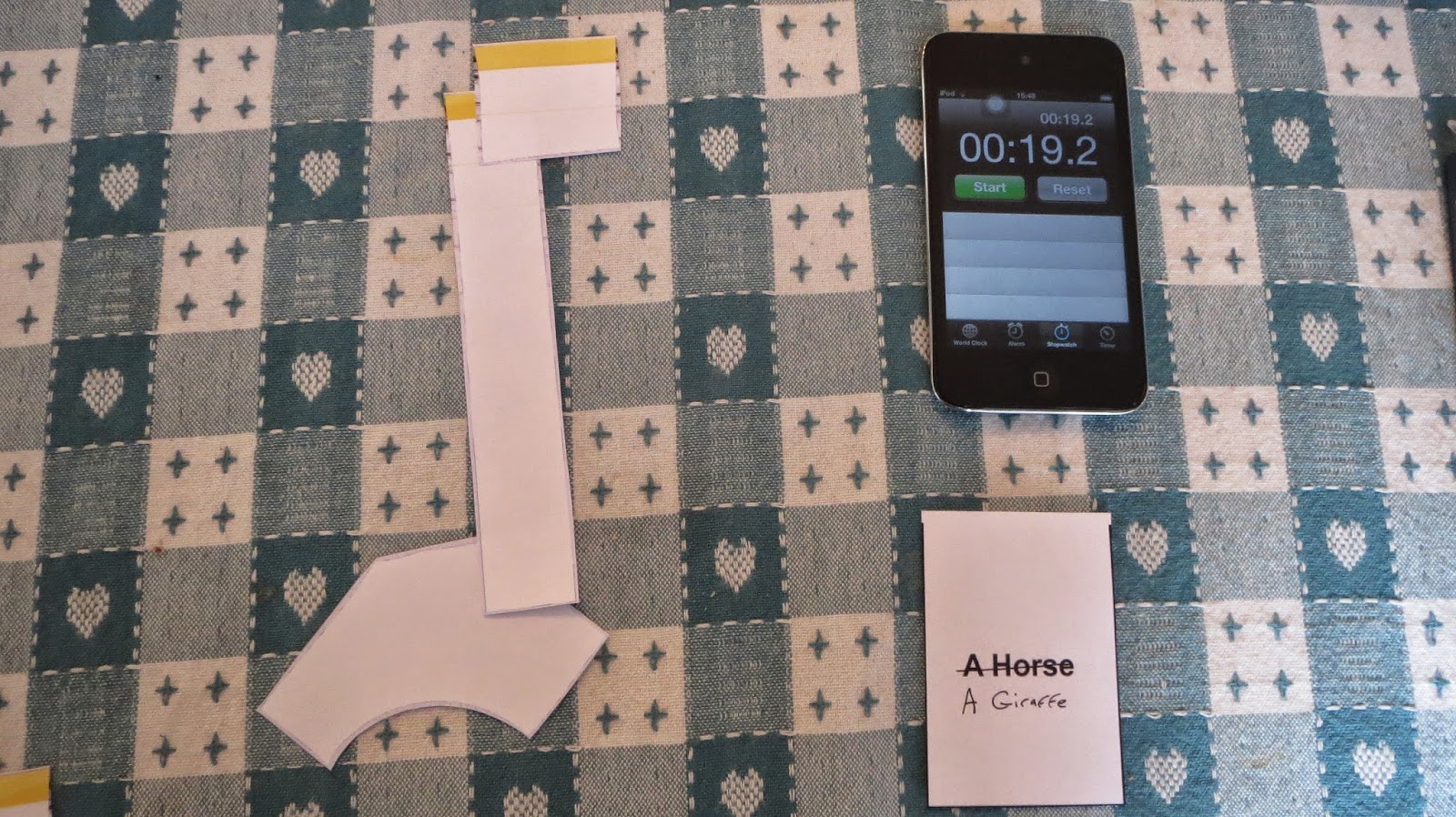
I went way over the time limit with these shapes. Is the time limit too short? No time limit?
I've only really tested the game with myself so far but I have a few revisions to make already:
- The first thing to note is that you can see through the cards. I'll have to print on thicker card next time.
- The game is currently too based on randomness. It is still predominantly up to the cards and shapes to decide whether your object is obvious or not. Potential solutions:
- 1. Limit the categories even more.
- 2. Make sure (or have a high chance) that each player consistently has a varied selection of shapes. To do this I could:
- 1. Give each player more than 7 shapes each.
- 2. Design the shapes very carefully so that they have lots of uses.
- 3. Have shape categories too. i.e. For the 'Animal' card there can 'Animal' shapes too which are generally more body, head, facial feature, limb shaped.
- Another smallish problem is that it is currently easy to cheat the shapes you get by feeling for which one you want. Solutions:
- 1. Embrace this and always allow the players to chose which shapes they want but rotate the chooser after each shape is chosen to keep it fair still. May help with the randomness problem too.
- 2. Rather than feeling the shapes, deal each player 7 cards which correlate to specific shapes.
There is a fine balance to made between giving the player enough variety to be creative and have a good chance of being successful but vague enough that different players with the same shapes and object would have different solutions.
Saturday, 26 July 2014
Game 03 - Card Game: 2 card games
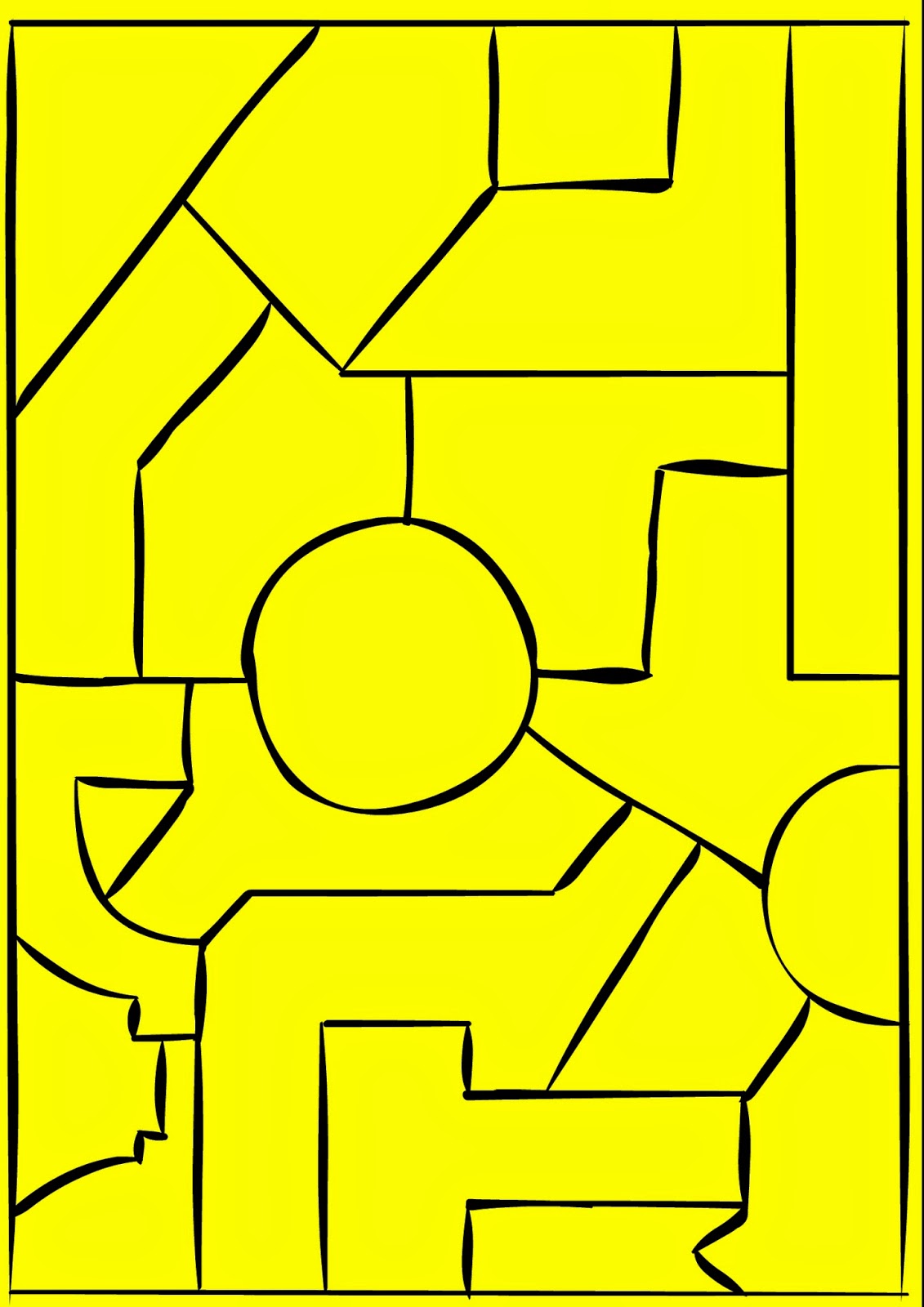
I have 2 ideas that I want to explore here.
The first one is very simple.
The Rules currently:
It's a 'kids' game for at least 3 players where you are given 7 random shapes (less if there are more than 3 players) cut from this template ->
Each person then chooses a card with an object written on it and does NOT show it to anyone else.
Everyone then has 20 seconds to make their object using EXACTLY 3 of their 7 shapes.
After these 20 seconds are up everyone other than the person who made the object (starting with the person on the object makers left) takes ONE guess at what the object is. Whoever guesses correctly gets 1 point and the object maker gets 1 point for everyone who guesses their object correctly.
continue guessing objects for everyone in the group. Once everyone's object has been guessed and points have all been added together, everyone puts the shapes they used into the shape pile and the process continues for a previously decided number of rounds.
When all the rounds are over and all the points have been added up, the winner is the person with the most points.
The second card game is far less fleshed out.
So I'll work on it some more and make a post tomorrow or something.
Friday, 25 July 2014
Game 03 - Card Game: Research and Idea Development
I've been playing 'Gods Will Be Watching' a fair amount since it was released yesterday and I love it. It was made with Game Maker: Studio too. I loved the original Ludum Dare entry as well. It's given me a few ideas about potential uses in a physical card game perhaps similar to One Night Ultimate Werewolf.
I'll be going back to my 'this is a cool mechanic, lets explore that' strategy for creating games next week. I've made little progress with this weeks game so far. That being said, I've had a pretty busy week and I am out of my comfort zone with card games so maybe I'll go back on my previous comment at some point =P
Today I made some quick generic(ish) cards today in Adobe Flash (took about an hour), printed and cut them out to see if they'd give me any ideas about interesting uses for them.
1. 2. 3. 4.
 1.
1.
The first two are inspired by trading and battling card games such as Yugioh, Magic:The Gathering or Pokemon. Generally each card represents a 'creature' which with offensive and/or defensive uses, and 'support' cards which are generally used to temporally change the rules of play, power up a 'creature' card, or give the player some kind of miscellaneous bonus which, when used in conjunction with other cards, varies in usefulness.
A lot of the strategy of these games comes prior to the 'battling' part; trading and putting together a deck of cards or two.
The rest of the strategy comes from the combining of various cards and card positions whilst taking into account random variables such as what card you'll get next (although you can often push the odds in your favor) and adapting to your opponents strategy.


I feel like I've made progress today actually. I like the ideas about the information economy and about making shapes into other things. I'll work some more on these ideas tomorrow.
I'll be going back to my 'this is a cool mechanic, lets explore that' strategy for creating games next week. I've made little progress with this weeks game so far. That being said, I've had a pretty busy week and I am out of my comfort zone with card games so maybe I'll go back on my previous comment at some point =P
Today I made some quick generic(ish) cards today in Adobe Flash (took about an hour), printed and cut them out to see if they'd give me any ideas about interesting uses for them.
1. 2. 3. 4.
The first two are inspired by trading and battling card games such as Yugioh, Magic:The Gathering or Pokemon. Generally each card represents a 'creature' which with offensive and/or defensive uses, and 'support' cards which are generally used to temporally change the rules of play, power up a 'creature' card, or give the player some kind of miscellaneous bonus which, when used in conjunction with other cards, varies in usefulness.
A lot of the strategy of these games comes prior to the 'battling' part; trading and putting together a deck of cards or two.
The rest of the strategy comes from the combining of various cards and card positions whilst taking into account random variables such as what card you'll get next (although you can often push the odds in your favor) and adapting to your opponents strategy.
2.
The second set of cards have more or less only writing on them. Similar to that of Cards against Humanity or Pictionary. The writing could be questions, answers, actions to perform by a player or players, information or perhaps something else.
I like the idea of the cards containing information available only to one or a few of the players. Tension in media always comes from someone (usually the viewer/player but sometimes one of the characters) having more information (or thinking they have more information) than somebody else. for example in the book and film, The Boy in The Striped Pyjamas:
SPOILERS:
When the Bruno and Shmuel enter the concentration camp dressed in 'stripped pyjamas' to look for Shmuels' dad, the viewer is fully aware of the danger to the two boys and Shmuel is partially aware whereas Bruno is completely oblivious. This economy of information creates one of the most suspenseful scenes in modern cinema and I assume it was even more powerful in the book.
END OF SPOILERS:
3.
These two cards could be used in a kind of pattern linking game. Perhaps the colors, shapes, quantity of colors and quantity of shapes are all linked to other things. The cards themselves remind me of a card game (I can't remember the name) I was introduced to at Games Brittania (a games festival held in the millennium gallery in Sheffield a few weeks back) where each card has a bunch of images on it, all cards share exactly one image in common with another card and every card is different. The aim of the game is to identify which image each card shares with the next card before your opponent.
4. The last two cards are similar to the third set of cards but the shapes are arranged in such a way that they vaguely represent objects or patterns.
Eg. The top one looks a bit like a plug socket and the bottom one looks a bit like a lamp.
I kept the different colors just because I'm sure I could add some kind of extra depth to the game with it.
An idea might be to have just a single shape or image on each card and to have the players arrange their cards (perhaps in teams) in order to try and produce recognized objects/patterns/shapes etc...
I feel like I've made progress today actually. I like the ideas about the information economy and about making shapes into other things. I'll work some more on these ideas tomorrow.
Wednesday, 23 July 2014
Harry Lee and Stuff
I was worrying about whether my Games Art and Design course was actually going to teach DESIGN like I usually do. I started looking through some of the blogs of previous students and I found a very interesting and relevant link through Simon Balciunas' Blog about a designer called Harry Lee.
Article about Harry Lee
I'd heard of Sneaky Cards before but it'd never crossed my mind that somebody actually designed them. I suppose I always assumed they were anonymous but after reading through this article I feel an overwhelming connection to this designer, Harry Lee.
Making weekly games is beneficial in so many ways but it does incentivise not really thinking through what you're actually making. It's benefits lie in knowledge about software, playability and design but not so much 'games as art', which is the reason I wanted to make games in the first place. I think I'd forgotten that a little bit but Harry Lee has reminded me how beautiful games can be and should be. He reminds me very much of myself =]
This article is also very interesting to me currently on the basis that 'Sneaky Cards' is a card game. I was thinking about interesting ways to use cards and 'Sneaky Cards' is a prime example of how to use them in this way.
Another example that springs to mind is Cards Against Humanity. Another independently designed card game which uses a card game differently (although not to the extent nor the same merits of Sneaky Cards).
Others could include:
- Cheat
- One Night Ultimate Werewolf
- 52 Card Pickup
- Building a house of Cards
all of which use the cards in a non-traditional way or explore interesting social interactions.
It's worth focusing my attention towards more traditional card games also (for context at least) such as:
- Solitare
- Magic: The Gathering
- Poker
- Card City Nights - by Ludosity (a fantastic team of developers)
Given how much play-testing card games generally require it's fairly likely that this 'weekly game' might take 2 weeks. I may also change the 'Greed' theme of the game.
Article about Harry Lee
I'd heard of Sneaky Cards before but it'd never crossed my mind that somebody actually designed them. I suppose I always assumed they were anonymous but after reading through this article I feel an overwhelming connection to this designer, Harry Lee.
Making weekly games is beneficial in so many ways but it does incentivise not really thinking through what you're actually making. It's benefits lie in knowledge about software, playability and design but not so much 'games as art', which is the reason I wanted to make games in the first place. I think I'd forgotten that a little bit but Harry Lee has reminded me how beautiful games can be and should be. He reminds me very much of myself =]
This article is also very interesting to me currently on the basis that 'Sneaky Cards' is a card game. I was thinking about interesting ways to use cards and 'Sneaky Cards' is a prime example of how to use them in this way.
Another example that springs to mind is Cards Against Humanity. Another independently designed card game which uses a card game differently (although not to the extent nor the same merits of Sneaky Cards).

Others could include:
- Cheat
- One Night Ultimate Werewolf
- 52 Card Pickup
- Building a house of Cards
all of which use the cards in a non-traditional way or explore interesting social interactions.
It's worth focusing my attention towards more traditional card games also (for context at least) such as:
- Solitare
- Magic: The Gathering
- Poker
- Card City Nights - by Ludosity (a fantastic team of developers)
Given how much play-testing card games generally require it's fairly likely that this 'weekly game' might take 2 weeks. I may also change the 'Greed' theme of the game.
Game 03 - A Card Game About Greed
I'm expecting this game to fail and that's good.
It is rare for me to start a project with a medium such as 'Card Game', 'Pencil and Watercolor' or 'FPS' because it's almost impossible to force creativity. The best ideas are always the ones you come up with when you're just nodding off to sleep, taking a shower, waiting for a bus, or enjoying a long car journey. Nevertheless, in the creative industry, briefs like 'Make a game about dogs' or 'Draw a character for children' are all too common in my opinion. Or it's not that they're TOO common. These kinds of requests are sometimes necessary but like I said, they rarely lead to fantastic ideas or creations.
Jon Blow did a talk on this but I can't find it for the life of me. The title had something to do Creative Burnout I think.

 My Conclusion:

So I'm having starting. With the first two projects I had a set mechanic I wanted to explore and I was able to implement and experiment with it strait away. Card Games take planning but I do feel like I should already be experimenting with physical prototypes. I might do that tomorrow.
It is rare for me to start a project with a medium such as 'Card Game', 'Pencil and Watercolor' or 'FPS' because it's almost impossible to force creativity. The best ideas are always the ones you come up with when you're just nodding off to sleep, taking a shower, waiting for a bus, or enjoying a long car journey. Nevertheless, in the creative industry, briefs like 'Make a game about dogs' or 'Draw a character for children' are all too common in my opinion. Or it's not that they're TOO common. These kinds of requests are sometimes necessary but like I said, they rarely lead to fantastic ideas or creations.
Jon Blow did a talk on this but I can't find it for the life of me. The title had something to do Creative Burnout I think.
So I'm having starting. With the first two projects I had a set mechanic I wanted to explore and I was able to implement and experiment with it strait away. Card Games take planning but I do feel like I should already be experimenting with physical prototypes. I might do that tomorrow.
Subscribe to:
Posts (Atom)